

Holistic Individualism vs Modern Collectivism In Sustainability
An Examination of Individualism and Collectivism in the Modern and Primitive Context

In the labyrinth of our contemporary society, a profound misunderstanding festers around the notion of individualism. Too often, it's equated with a selfish, me-first approach, clashing with the ideals of collective good. This form of self-centeredness, rampant in our era, I believe, is the fallout of the authentic individualism that our technological civilization strips away from us. It's time to redefine our understanding, to introduce what I call 'holistic individualism' - a term that encapsulates the quintessential human experiences of finding purpose, exerting effort, and achieving goals through individual initiative. Far from being at odds with community health and resilience, holistic individualism, echoing the lifestyles and values of primitive societies, is vital for both.
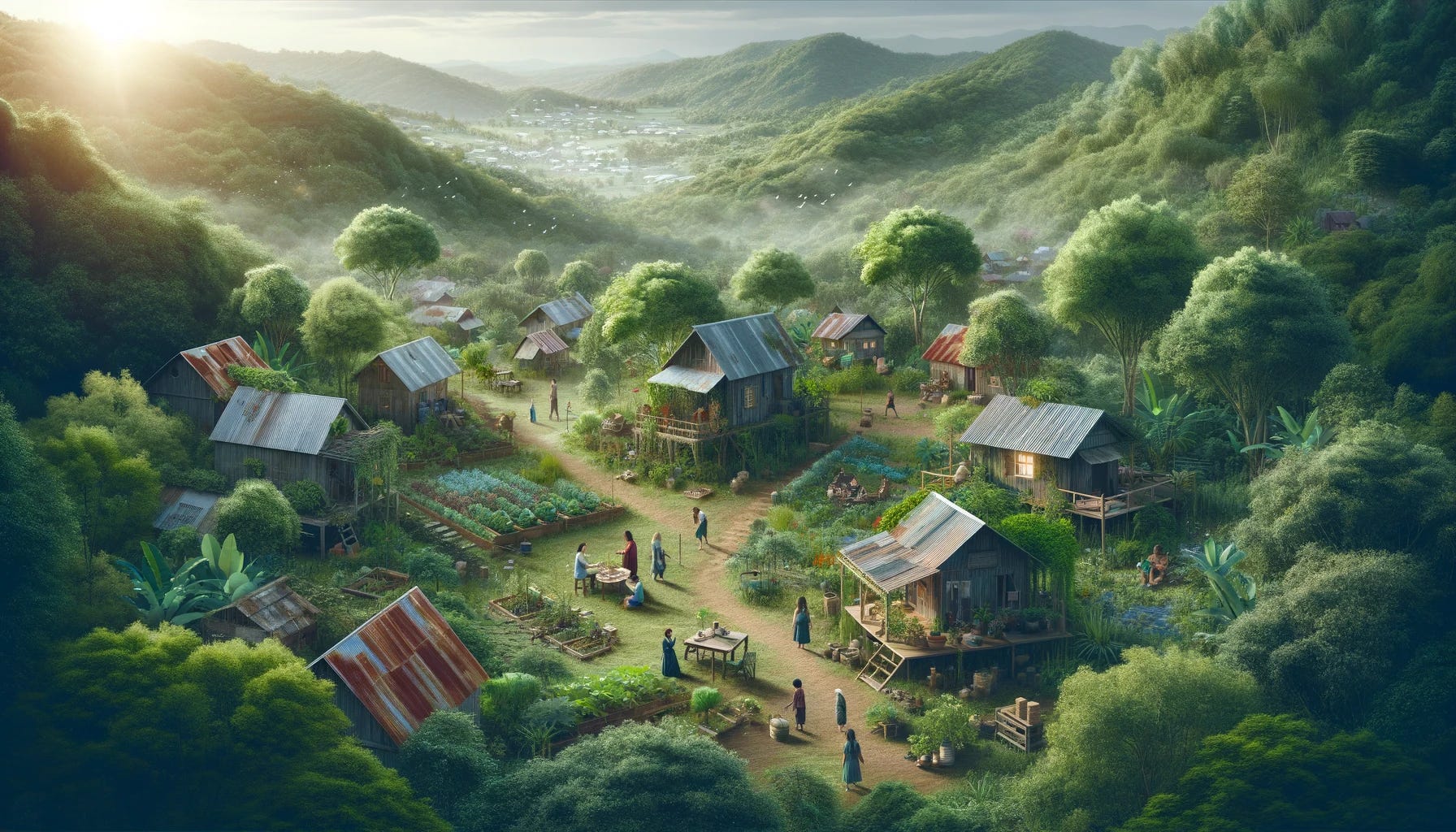
Defining Primitive
In using the term 'primitive,' it's essential to clarify its true meaning, often misconstrued as 'inferior' or 'lesser.' In our conversation, 'primitive' refers to the fundamental, original state of human existence. It's an invocation of a time when life was deeply entwined with the rhythms of nature and community. This term is not a pejorative but a celebration of the most authentic and fulfilling human experience, unmarred by the complexities and distortions of our modern industrial society. It signifies a way of being that's whole, integrated, and in tune with our innate nature and the world around us.
Primitive Autonomy and Holistic Individualism
Holistic individualism, related to what could be called 'primitive autonomy,' is about the self-determination found in societies that allowed for the pursuit of intrinsic human needs and goals, achieved autonomously, something remarkably absent in contemporary society. We rely on large out-of-reach organizations, both public and private, to provide those things for us. We work for them to obtain what they provide.
In preindustrial societies, particularly primitive ones, autonomy meant being able to provide our intrinsic human needs to ourselves. In this sense, individualism wasn't about isolation or selfishness; it was about fulfilling one's role within the natural order of life. The pursuit of personal needs was in concert with the welfare of the community and environment.
The pursuit of an individual's aspirations wasn't a solitary journey but a communal effort. The efforts to secure food, shelter, and safety, or to partake in the rituals and customs of the community, were not only acts of personal fulfillment but also contributions to the group's collective resilience and prosperity.
Modern “Individualism”
Contrast this with what passes for individualism today—a pursuit of hollow goals like material wealth and social status, which fail to satiate our fundamental human needs and stand as weak substitutes for primal fulfillment. This modern 'individualism' demands allegiance to the system, overshadowing the needs of the individual or smaller groups. This deviation from true individualism is more than a misstep; it's a detachment from what it fundamentally means to be human.
Chasing after fleeting goals dictated by societal standards leaves many feeling empty, their psychological needs for autonomy and purpose unmet. This relentless pursuit, or the despair stemming from its unattainability, is a symptom of a deeper malaise. The focus on serving the system severs the crucial link between the individual and their immediate community, eroding the dynamics of small group interactions and leaving a void of isolation and unfulfillment.
In the face of this modern distortion, holistic individualism emerges not just as a path back to our roots but as a clarion call to reclaim our true nature. It's an opportunity to reforge our bonds with the community and the planet, a chance to rediscover the harmony between our individual pursuits and the collective good. This is the essence of holistic individualism—a return to a way of living that directly nurtures both the self and the community, offering a path to a more balanced, fulfilling existence.
Modern "Collectivism”
In our era, the concept of collectivism, particularly as espoused by modern leftist ideologies, often reflects a similar ailment as that of contemporary individualism: a deep-seated allegiance to the overarching system rather than to the real needs of individuals or local communities. This modern collectivism significantly departs from the essence of holistic individualism.
The modern collectivist approach predominantly advocates for the interests of larger societal groups, sometimes overshadowing the unique needs of smaller communities and the autonomy of the individuals within them. It frequently prioritizes systemic, large-scale solutions and policies, overlooking the nuanced dynamics of local communities and individual aspirations. This can lead to individuals and local groups feeling like mere components in a vast machine, losing their sense of direct impact and personal significance in their own environments.
The critique of modern collectivism stems from its tendency to homogenize the diverse tapestry of individual and local group needs into a uniform set of systemic priorities. This often happens under the influence of distant authorities or broad ideological frameworks, potentially ignoring the intricate details and specific needs of local cultures, environments, and individuals.
Holistic Individualism as Community-Oriented Resistance
Confronting a system that incessantly promotes rampant consumption and the relentless pursuit of material wealth, holistic individualism stands as a defiant alternative. It urges individuals to redefine success and fulfillment, not in the conventional terms of material accumulation or social status, nor by service to the system, but within the context of contributing positively to the well-being of themselves, their communities, and the natural world. This paradigm shift poses a direct challenge to the consumerist ethos, emphasizing life quality, sustainable living, and community welfare over personal material gain.
This individualism cultivates a sense of empowerment and self-reliance within communities. As individuals engage more intimately with their immediate environments and collaborate to address communal needs, they develop crucial skills and relationships for long-term sustainability. This empowerment allows communities to become more self-reliant, lessening their dependence on external exploitative systems and resources.
Essentially, practicing holistic individualism as a form of community-oriented resistance is about reclaiming the autonomy and agency stripped away by modern industrial society. It's about restoring a balance where individual actions and aspirations harmonize with the health of the community and the planet. Aligning individual pursuits with collective well-being, this form of individualism transforms into a formidable force for sustainable transformation, nurturing communities that are resilient, self-sustaining, and deeply connected to the core of human existence.
Implementing Holistic Individualism in Modern Societies
The harsh truth is that holistic individualism is largely absent in modern society, as the prevailing system doesn't easily permit it. Yet, its resurgence is vital now more than ever. Implementing holistic individualism in our daily lives is a radical act of defiance against a system that often undermines genuine human fulfillment and ecological balance.
Practical Applications for Individuals
Essentially the goal is to acquire our essential human needs like food, water, shelter, as much as possible on our own and within our community, without interference from the industrial system. Here are some places to start:
Mindful Consumption: Embrace simplicity and sustainability in lifestyle choices. This means prioritizing genuine needs over desires, minimizing waste, and opting for products and services that are as environmentally considerate and ethically produced as possible.
Local Engagement: Actively participate in local community activities. This can include supporting local businesses, joining community gardens, or engaging in local decision-making processes such as town hall meetings.
Skill Development: Acquire skills that contribute to both personal growth and community resilience. This could involve learning traditional crafts, bushcraft, basic home repair, gardening, or other skills that reduce dependence on large-scale systems.
Building Relationships: Cultivate strong relationships within the community. This includes not only family and friends but also neighbors and local groups, fostering a network of mutual support and cooperation.
Role of Community Initiatives
Community initiatives can provide platforms for sharing resources and skills, such as tool libraries, skill-sharing workshops, and community-led educational programs.
Establish local markets and cooperatives to encourage the circulation of goods and services within the community, keeping economic benefits localized and building economic resilience.
Embracing holistic individualism in our modern societies is a call to action. It's an invitation to step back from the precipice of a system that values profit over people and to walk a path that leads us closer to our true human nature—one that is inextricably linked to the health of our communities and the natural world. It's a journey back to our roots, where individual fulfillment and community well-being are not just possible but are naturally intertwined.
I hope this conceptual framework makes as much sense to you as it does to me. As always, I am happy to discuss in the comments below or on your favorite social media platform.
President Theodore Roosevelt (in his 1901 State of the Union address) praised the Dawes Allotment Act for targeting tribal ways of life. He said, “The General Allotment Act is a mighty pulverizing engine to break up the tribal mass. It acts directly upon the family and the individual. . . . The Indian should be treated as an individual—like the white man.”
The target was precisely communal life!
What a shame. The US probably remembered how dangerous tribal life was in Scotland to the establishment rule.